2026-05-05
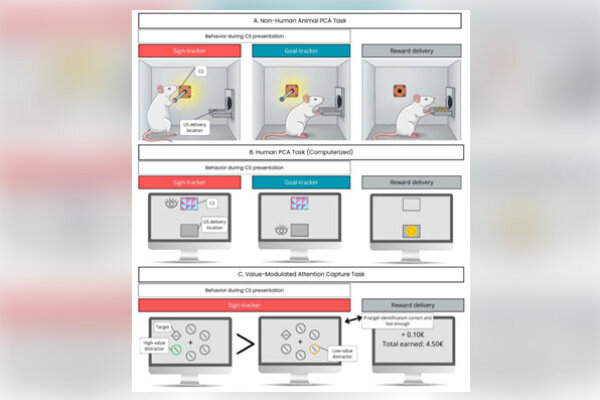
Motivational and attentional processes jointly determine how environmental cues influence behavior. Reward-predictive cues can acquire incentive salience, automatically capturing attention and eliciting approach responses even in the absence of deliberate intention, a phenomenon central to both adaptive behavior and certain forms of psychopathology. This review integrates animal and human evidence to examine how cue-triggered motivation and attention interact, and how these interactions are shaped by reward uncertainty, a dimension that has received limited interest in human research despite its robust effects in animals. Across species, uncertain or variably reinforced cues reliably intensify motivated behaviors. In animals, they enhance sign-tracking and promote persistent cue-directed responding, while in humans, paradigms such as uncertainty-modulated attentional capture (UMAC) show that uncertain cues exert a greater pull on attention, even when this impairs performance. We argue that these effects reflect an evolutionarily conserved mechanism that biases organisms toward exploration and information-seeking under unpredictable conditions. However, the same mechanisms can become maladaptive in modern environments, such as gambling or drug use, where artificially amplified reward signals can mimic or exaggerate the motivational impact of uncertainty, leading to compulsive cue attraction. By bridging motivational and attentional perspectives across animal and human research, this review offers a unified framework for understanding how reward cues gain motivational significance, how uncertainty modulates these processes, and why they may contribute to vulnerability in addiction-related behaviors.
Motivational and attentional processes jointly determine how environmental cues influence behavior. Reward-predictive cues can acquire incentive salience, automatically capturing attention and eliciting approach responses even in the absence of deliberate intention, a phenomenon central to both adaptive behavior and certain forms of psychopathology. This review integrates animal and human evidence to examine how cue-triggered motivation and attention interact, and how these interactions are shaped by reward uncertainty, a dimension that has received limited interest in human research despite its robust effects in animals. Across species, uncertain or variably reinforced cues reliably intensify motivated behaviors. In animals, they enhance sign-tracking and promote persistent cue-directed responding, while in humans, paradigms such as uncertainty-modulated attentional capture (UMAC) show that uncertain cues exert a greater pull on attention, even when this impairs performance. We argue that these effects reflect an evolutionarily conserved mechanism that biases organisms toward exploration and information-seeking under unpredictable conditions. However, the same mechanisms can become maladaptive in modern environments, such as gambling or drug use, where artificially amplified reward signals can mimic or exaggerate the motivational impact of uncertainty, leading to compulsive cue attraction. By bridging motivational and attentional perspectives across animal and human research, this review offers a unified framework for understanding how reward cues gain motivational significance, how uncertainty modulates these processes, and why they may contribute to vulnerability in addiction-related behaviors.

Copyright © BioPsy 2026
Last update: May 05, 2026