2026-05-10
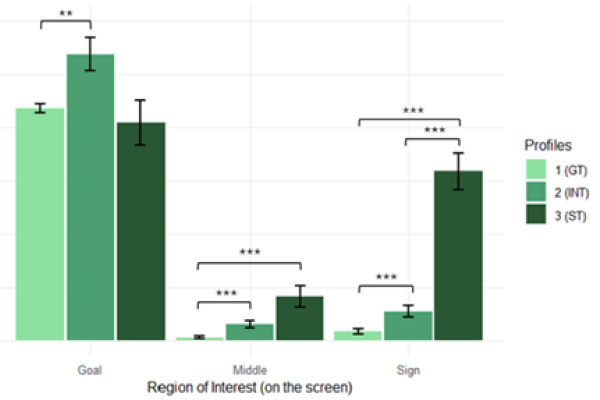
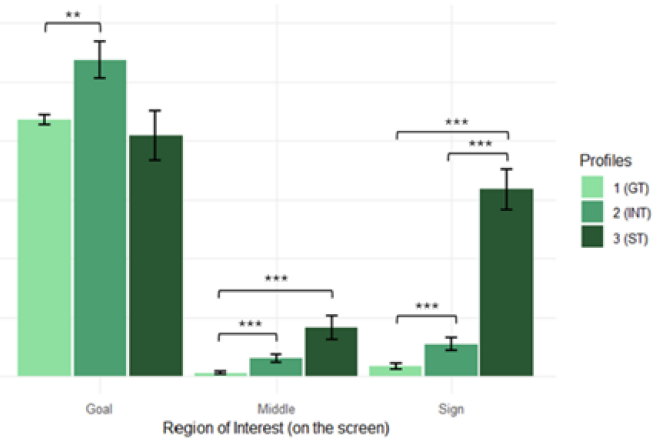
Individuals differ in their tendency to assign motivational value to reward-predictive cues, conceptualized as “sign tracker” (ST) versus “goal tracker” (GT) behaviors in animal models. STs approach a rewardpredictive cue, while GTs go to the location of reward delivery. An intermediate phenotype is sometimes identified. These profiles have been linked to addiction vulnerability because of a higher propensity to signtrack in drug-addicted rats. However, efforts to translate this model to humans have yielded inconsistent findings, partly because of variability in experimental paradigms. The present observational study hypothesized that distinct profiles based on gaze behavior could be identified in humans and that these profiles would differ on addiction-related variables, such as alcohol consumption and impulsivity. One hundred six adults completed three computerized tasks: a simple reward task, a Pavlovian conditioned approach task, with gaze behavior measured via eye tracking, and a dot-probe task. Participants were categorized as STs, GTs, or intermediate phenotypes with a latent profile analysis. Alcohol consumption and personality traits were assessed via questionnaires. The three profiles significantly differed in alcohol consumption level, with a small-to-medium effect size observed (χ2=8.10, p=.01, η2= .059). STs displayed higher levels of alcohol consumption than GTs (p=.03). No significant differences emerged for other alcohol-related or personality variables. These findings demonstrate the feasibility of identifying ST/GT profiles (or analogues) in humans using a simple Pavlovian conditioned approach task. The observed link between sign tracking and alcohol consumption supports the notion that sign tracking may serve as a vulnerability marker of alcohol use.
Individuals differ in their tendency to assign motivational value to reward-predictive cues, conceptualized as “sign tracker” (ST) versus “goal tracker” (GT) behaviors in animal models. STs approach a rewardpredictive cue, while GTs go to the location of reward delivery. An intermediate phenotype is sometimes identified. These profiles have been linked to addiction vulnerability because of a higher propensity to signtrack in drug-addicted rats. However, efforts to translate this model to humans have yielded inconsistent findings, partly because of variability in experimental paradigms. The present observational study hypothesized that distinct profiles based on gaze behavior could be identified in humans and that these profiles would differ on addiction-related variables, such as alcohol consumption and impulsivity. One hundred six adults completed three computerized tasks: a simple reward task, a Pavlovian conditioned approach task, with gaze behavior measured via eye tracking, and a dot-probe task. Participants were categorized as STs, GTs, or intermediate phenotypes with a latent profile analysis. Alcohol consumption and personality traits were assessed via questionnaires. The three profiles significantly differed in alcohol consumption level, with a small-to-medium effect size observed (χ2=8.10, p=.01, η2= .059). STs displayed higher levels of alcohol consumption than GTs (p=.03). No significant differences emerged for other alcohol-related or personality variables. These findings demonstrate the feasibility of identifying ST/GT profiles (or analogues) in humans using a simple Pavlovian conditioned approach task. The observed link between sign tracking and alcohol consumption supports the notion that sign tracking may serve as a vulnerability marker of alcohol use.

Copyright © BioPsy 2026
Last update: May 10, 2026