2026-05-27
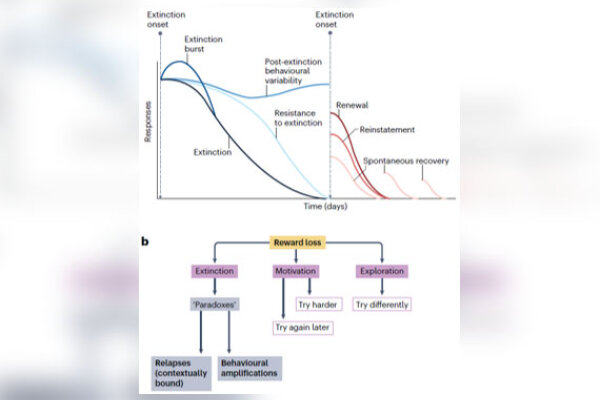
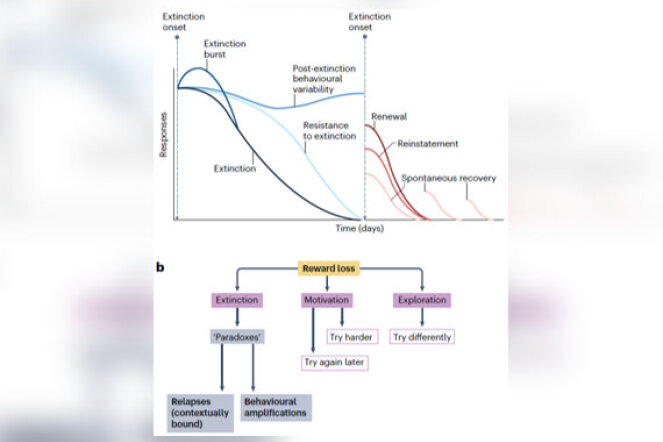
In extinction learning, a behaviour that was previously learned is extinguished when it no longer occurs in response to a target stimulus. However, laboratory research with non-human animals has revealed ‘paradoxes’ that consist of relapses or amplifications of the extinguished behaviour. In this Perspective, we examine extinction learning as a psychological mechanism and as an evolutionary adaptation. Relapse effects (including spontaneous recovery, renewal and reinstatement) and amplification effects (including extinction burst, increased behavioural variability and the partial reinforcement effect) reflect evolutionarily developed strategies to optimize survival in unpredictable environments. In the wild, reward loss motivates exploration and enables organisms to re-engage when success is possible. This functional interpretation combines psychological and ecological interpretations to redefine extinction as an adaptive search process and provides new insights for psychology and neuroscience.
In extinction learning, a behaviour that was previously learned is extinguished when it no longer occurs in response to a target stimulus. However, laboratory research with non-human animals has revealed ‘paradoxes’ that consist of relapses or amplifications of the extinguished behaviour. In this Perspective, we examine extinction learning as a psychological mechanism and as an evolutionary adaptation. Relapse effects (including spontaneous recovery, renewal and reinstatement) and amplification effects (including extinction burst, increased behavioural variability and the partial reinforcement effect) reflect evolutionarily developed strategies to optimize survival in unpredictable environments. In the wild, reward loss motivates exploration and enables organisms to re-engage when success is possible. This functional interpretation combines psychological and ecological interpretations to redefine extinction as an adaptive search process and provides new insights for psychology and neuroscience.

Copyright © BioPsy 2026
Last update: May 27, 2026